 SOFT
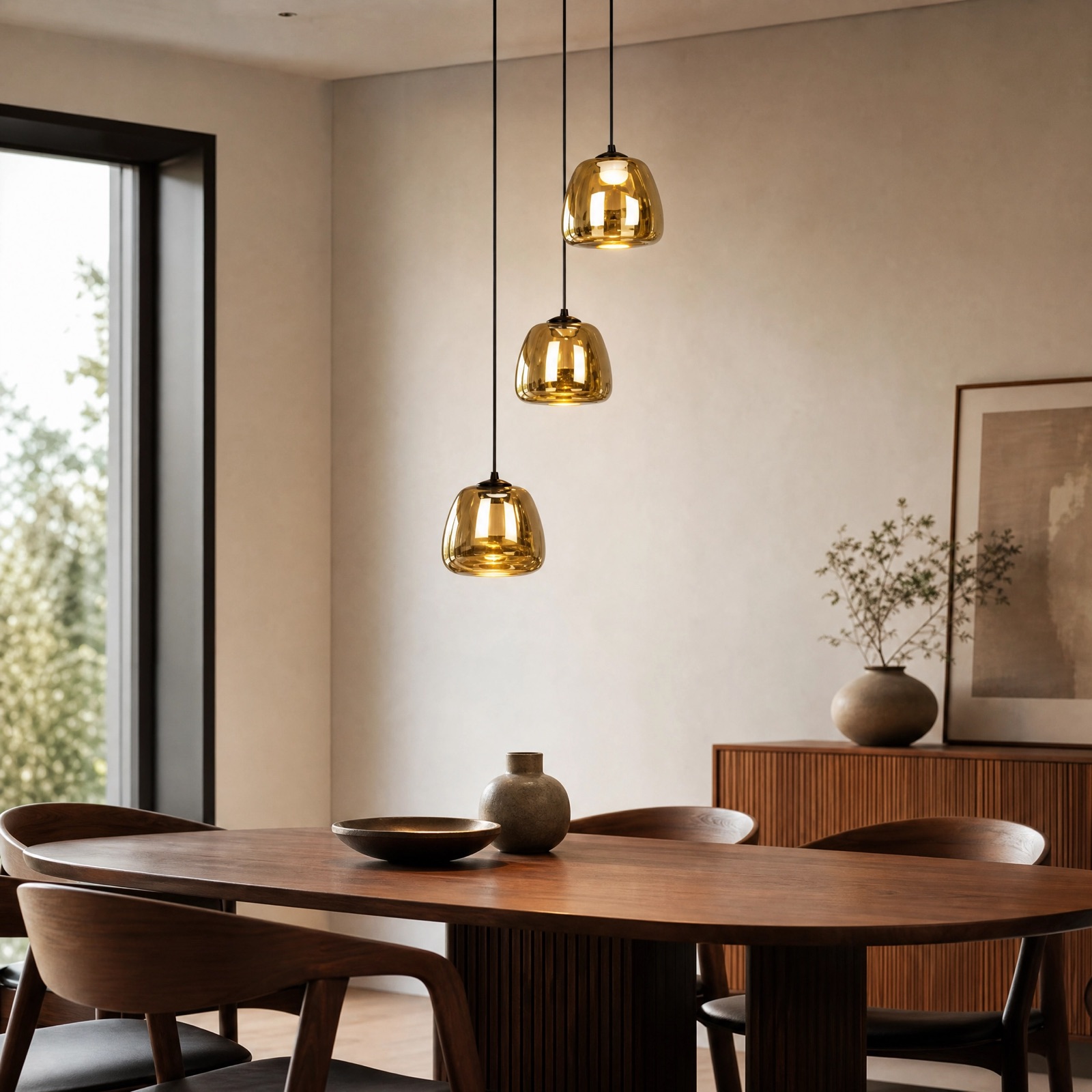
Colour temperature decides whether a space feels warm, professional or clinical — and whether the hundredth fixture matches the first. Here is how buyers choose between 2700K, 3000K, 4000K and 5000K, with real data from our own catalogue on where the market actually lands.
- Which colour temperature should you choose?
- What colour temperature actually measures
- The four working temperatures
- What 512 catalogue models say about 3000K
- Mixing temperatures within one scheme
- Binning: the question most buyers forget to ask
- CRI: the other half of light quality
- Dimming behaviour and warm-dim
- Three scenarios, three different answers
- How to specify CCT in an RFQ
Which colour temperature should you choose?
Short answer: 3000K for almost everything in hospitality, retail and residential; 2700K when you want candle-warm intimacy in bedrooms and lounges; 4000K for working interiors — offices, kitchens, bathrooms; 5000K only where colour judgement is the job, like workshops and print shops. If you remember one line, remember this: when undecided, 3000K.
The rest of this guide explains why that default holds across markets, what the data from our own order book shows, and the one technical question — binning — that most buyers only discover after the mismatch is on the ceiling.
What colour temperature actually measures
CCT, in kelvin, describes the tint of white light: lower is warmer and more amber, higher is cooler and bluer. It says nothing about brightness — a 2700K lamp and a 5000K lamp at identical wattage can post the same lumens while feeling like different rooms. The number comes from comparing the light to a theoretical black-body radiator, which is why the scale feels backwards to newcomers: firelight sits low (around 1800–2000K), overcast daylight high (6500K+).
Two related terms belong in the same conversation: CRI (how faithfully colours render under the light, 0–100) and SDCM (how tightly the colour point is controlled in production — more on that below). Buyers who specify all three get rooms that feel right and stay consistent; buyers who specify only CCT get surprises.
The four working temperatures
Almost every project resolves to one of four working temperatures. Each has a comfort zone and a failure mode:
| CCT | Character | Best for | Watch out |
|---|---|---|---|
| 2700K | Extra warm, candle-like | Hotel guest rooms, bedrooms, upscale restaurants | Poor colour discrimination for tasks |
| 3000K | Warm white | Hospitality, retail, living spaces — the working default | Slightly cosy for detailed work |
| 4000K | Neutral white | Offices, corridors, kitchens, bathrooms | Institutional feel in living spaces |
| 5000K | Cool daylight | Workshops, task areas, colour-checking goods | Clinical and flat in residential settings |
What 512 catalogue models say about 3000K
We parsed the colour-temperature field across our entire 2025–2026 catalogue. The distribution is not subtle:
Mixing temperatures within one scheme
The working rule: one CCT per visible zone. Guests should never see two temperatures side by side in one sightline — the eye reads the mismatch instantly, even when both fixtures are individually fine. Transitions between rooms, or between inside and outside, are natural and expected.
- Hotel guest room: 2700–3000K throughout, including the bathroom — a 4000K bathroom mirror next to a 2700K bedroom reads as a fault
- Retail store: 3000K general and accent alike; consistency is what makes merchandise colour look deliberate
- Office: 4000K at workstations, 3000K in lounge and reception — the contrast marks the mode change
- Whole house: 3000K everywhere, 2700K as an optional bedroom override
Binning: the question most buyers forget to ask
LED manufacturing sorts chips into bins by colour point, and the sorting tolerance is measured in SDCM (standard deviation of colour matching). Two 3000K fixtures from loose bins can sit visibly far apart on the ceiling — one greenish, one pinkish — despite identical datasheets. For project quantities, commit to 3-step SDCM or better in writing, and ask how bins are held across production runs, not just within one batch.
This is a factory-versus-trader question more than a price question. Holding tight bins requires volume buying from LED makers and inventory discipline across orders. Our IQC gate verifies bins against the purchase spec precisely because repeat orders must match the golden sample, not the brochure. Ask any supplier how they do it; the fluency of the answer tells you who you are dealing with.
CRI: the other half of light quality
CCT sets the mood; CRI decides whether things in the room look good under it. At 80 CRI, colours are acceptable and costs are lower. At 90+, reds and skin tones render properly — which is why apparel, food and cosmetic retail justifies the premium without hesitation. There is also a special case worth knowing: R9 (deep red) performance. A lamp can post 90 CRI overall yet render reds poorly if R9 is weak; fresh food and wood merchandising suffer visibly.
Our standard catalogue heads run 80+ CRI, with 90+ available on project orders for the categories that need it. When you compare quotes, check that CRI is measured, not assumed — and treat any supplier who cannot state R9 as a signal to look deeper.
Dimming behaviour and warm-dim
Fixed-CCT fixtures hold their temperature as they dim — the room gets darker but not warmer, which is the opposite of how incandescent light behaved and the reason some hospitality clients find LED dimming 'cold'. Warm-dim (sometimes called dim-to-warm) technology solves this: around 2200–2700K at low output climbing to 3000K at full, mimicking the old behaviour. It costs more and suits restaurants and hotel lounges above all.
Also worth specifying: the dimming curve. A linear curve wastes the bottom ten per cent of the range on imperceptible change; a log curve puts the useful control where your hand actually operates. If the project has a dimming system already, tell us the protocol — matching driver to system up front avoids the flicker complaints that no fixture can be retrofitted out of.
Three scenarios, three different answers
Theory is easier to judge against real briefs, so here are three we see constantly — and what we actually recommend in each case.
- A 40-key boutique hotel, one operator: 2700K in guest rooms and suites, 3000K in corridors, lobby and restaurant. The property reads warm everywhere, back-of-house stays practical, and the two temperatures never share a sightline.
- A fashion chain, 120 stores with a rollout schedule: 3000K throughout with 90+ CRI accents on the feature walls. One CCT means one SKU per fixture family — which keeps spare-part logistics for the chain trivial and every store identical on social media.
- A homeware showroom mixing textiles, wood and appliances: 3000K as the ambient layer, 4000K confined to a appliance demonstration bay behind a joinery break. The contrast is used deliberately to make the appliance bay read 'technical' next to the warm living sets.
How to specify CCT in an RFQ
A clean specification line prevents most colour disputes. Use this shape:
- CCT: 3000K ± tolerance per SDCM (state 3-step or better for projects)
- CRI: 80+ standard, 90+ with R9 > 50 where merchandise demands it
- Consistency: bins held across production runs, verified against golden sample
- Dimming: protocol and curve, or warm-dim where specified
- Verification: request two units from different production dates for side-by-side check
Quick answers
Is 3000K or 4000K better for retail?
For most merchandise, 3000K — it flatters wood, textiles and skin tones. 4000K suits electronics, hardware and pharmacies where a neutral, clinical read is preferred.
Can fixtures change colour temperature when dimmed?
Fixed-CCT fixtures cannot. Tunable-white and warm-dim models can — warm-dim runs roughly 2200–3000K across the dimming range and is popular for restaurants and hotel lounges.
What SDCM should I require?
3-step SDCM or better for project quantities. It keeps fixtures from different production runs looking identical on the ceiling. Get it in writing, not just on a datasheet.
Does CCT affect lumen output?
Slightly — cooler CCTs often test marginally brighter for the same wattage. Compare lumens, not kelvins, when evaluating output.
Why does my 3000K order look different from the sample?
Almost always binning. Loose bin control lets colour points drift between production runs. Require 3-step SDCM and golden-sample verification to prevent it.
Which CCT for hotel guest rooms?
2700–3000K throughout, including the bathroom. A cooler bathroom next to a warm bedroom reads as a fault to guests even when both fixtures are working correctly.